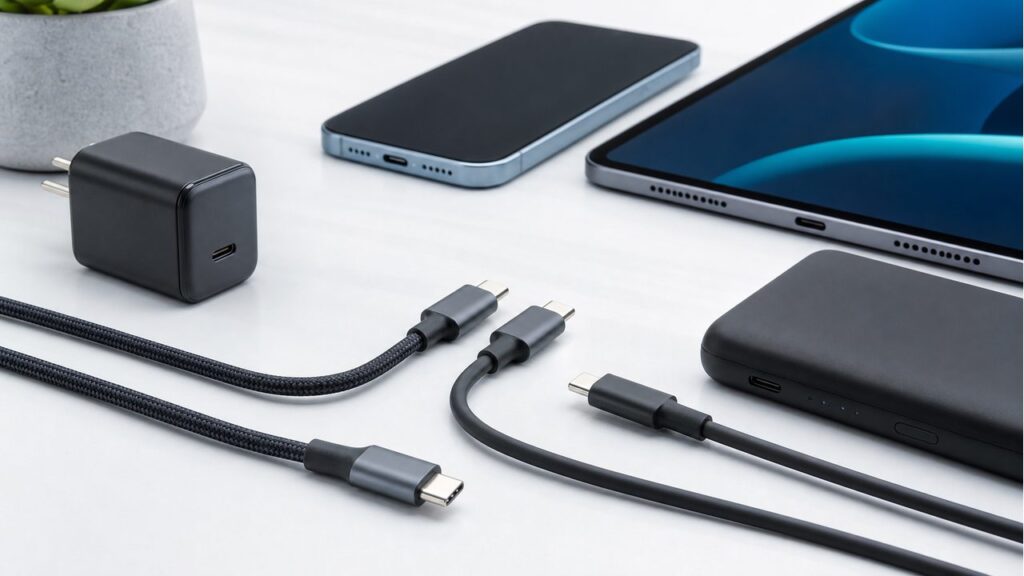
A fast charger is only half the setup. The cable decides whether your phone, tablet, power bank, or laptop can actually use the wattage you paid for. This guide focuses on power rating, E-marker support, data speed, cable length, and realistic device fit.
Buyer verdict: which cable should you choose?
Choose the UGREEN 100W USB-C cable if you want a safe everyday laptop/phone charging cable and do not need high-speed file transfer.
Choose the Spigen 100W USB-C cable if data speed matters along with charging. Its USB 3.2 and 5Gbps positioning makes it the better pick for file transfers than basic charging-only cables.
Choose the Stuffcool Duplo 140W cable if you want a higher-power, travel-friendly cable with dual Type-C connector flexibility.
Quick picks
| Product | Best for | Why it stands out | CTA |
|---|---|---|---|
| UGREEN 100W USB-C Cable | Reliable everyday USB-PD charging | 100W PD support, E-marker positioning, durable build claims, and a clear role for phones, tablets, and laptops. | Check price on Amazon |
| Spigen 100W USB-C Cable | Charging plus faster data transfer | 100W charging, USB 3.2, 5Gbps data positioning, and E-marker support make it the spec-focused pick. | Check price on Amazon |
| Stuffcool Duplo 140W Cable | Higher-power travel charging | 140W-class positioning, E-marker chip, nylon braided build, and dual Type-C connector convenience. | Check price on Amazon |
| Ambrane 100W USB-C Cable | Value charging backup | A useful lower-cost candidate when you want a spare 100W-class charging cable for bag or desk use. | Check price on Amazon |
Best everyday pick: UGREEN 100W USB-C Cable
Verdict: UGREEN is the sensible default if your priority is dependable USB-PD charging for phones, tablets, power banks, and many USB-C laptops. It is not the pick for people who move large files daily.
Pros
- 100W charging support: Enough for many thin-and-light laptops when paired with a compatible charger.
- E-marker positioning: Important for higher-watt USB-C power delivery above basic charging levels.
- Simple daily role: Easy to keep in a laptop bag or on a desk as the main charging cable.
Cons
- Basic data speed on many variants: Do not assume it is a high-speed transfer cable.
- Variant confusion: Length and packaging can vary, so check the exact listing before buying.
- Not needed for low-watt devices: A basic phone charger may not benefit from a high-watt cable.
Good fit: You need one cable for phone, tablet, power bank, and USB-C laptop charging.
Skip if: You regularly transfer large files and need USB 3.x speeds.
Best for data plus charging: Spigen 100W USB-C Cable
Verdict: Spigen is the better pick if you want one cable for charging and occasional high-speed data transfer. That matters for external SSDs, phone backups, and moving media files.
Pros
- 100W plus 5Gbps positioning: Better balanced than cables that charge fast but transfer slowly.
- E-marker support: A useful safety and compatibility cue for higher-watt charging.
- Good device spread: Works conceptually across phones, tablets, wearables, and laptops with USB-C.
Cons
- Overkill for charging only: If you never move files, a simpler cable may be enough.
- Check exact length: Longer cables are convenient but can be less tidy for travel.
- Still not a Thunderbolt cable: Do not treat 5Gbps as the same class as USB4 or Thunderbolt.
Good fit: You want charging and useful data speed from one USB-C cable.
Skip if: You only need a cheap spare cable for a bedside phone charger.
Best high-power travel candidate: Stuffcool Duplo 140W Cable
Verdict: The Stuffcool Duplo is for buyers who carry stronger USB-C chargers or high-output power banks and want one cable that feels ready for heavier charging setups.
Pros
- Higher power ceiling: Useful if your charger, laptop, or power bank supports higher USB-PD levels.
- E-marker chip: Important for communicating cable capability to compatible chargers and devices.
- Travel-friendly idea: A stronger cable can reduce the need to carry multiple similar cables.
Cons
- Only useful with the right hardware: A lower-power charger or phone will not use the full headroom.
- May be bulkier than basic cables: Higher-power braided cables can be less pocketable.
- Check device support: Not every laptop needs or accepts above 100W over USB-C.
Good fit: You carry a high-output charger or power bank and want a cable that can keep up.
Skip if: You only charge a phone overnight or want the thinnest cable possible.
Best value backup: Ambrane 100W USB-C Cable
Verdict: Ambrane is the practical backup-cable option. It makes sense if you want a spare cable for a desk, bag, or power bank without treating it as your one cable for every job.
Pros
- Useful wattage class: Good enough for many phone, tablet, and laptop charging setups.
- Backup role is clear: Better than depending on the thin cable that came with an old accessory.
- Good for power-bank pairing: A rated USB-C cable helps high-output power banks perform properly.
Cons
- Verify exact listing details: Cable specs and lengths can vary by listing and variant.
- Do not assume fast data: Treat it mainly as a charging cable unless the listing says otherwise.
- Not the premium pick: Choose Spigen or UGREEN if spec clarity is more important than value.
Good fit: You want a sensible spare 100W-class charging cable.
Skip if: You need a single premium cable for charging, data, and travel.
How to choose without getting trapped by the watt number
- For phones: Make sure the charger and phone support the same fast-charge standard. A high-watt cable alone is not enough.
- For laptops: Match the laptop’s USB-C charging requirement, the charger’s output, and the cable’s rating.
- For power banks: Use a cable that supports the bank’s input and output wattage. This affects both charging your phone and recharging the bank.
- For file transfer: Look for explicit data speed claims. Many strong charging cables are still basic data cables.
Related reading
Best USB-C Chargers in India | Charger Watts Explained | Best Power Banks | Unit Converter
Bottom line
Most people should buy a clearly rated USB-C cable that matches their charger and device, not the flashiest cable on the listing page. UGREEN is the practical everyday pick, Spigen is better when data transfer matters, Stuffcool is the higher-power travel candidate, and Ambrane works as a value backup.
Product names, availability, cable length, connector finish, and listed specifications can change. Recheck the exact retailer page before buying.